
DAMIAN ELWES (b1960)
“I want these paintings to offer hope in these troubled times. My paintings peer into private spaces where artists have used their creativity and imagination to change the way we perceive the world.” Damian Elwes
View all Works

THE EARLY YEARS
Damian Elwes was born in London on 10 August 1960 into a family of artists. His grandfather and father were both portrait painters and left him their easels and brushes when they passed away. Elwes was not immediately drawn to follow in his father’s footsteps but rather favoured a career as a playwright and was accepted on a course of study at Harvard University. At graduation, his professor gave him a palette knife that had once belonged to Henri Matisse, possibly anticipating his future career as an artist.
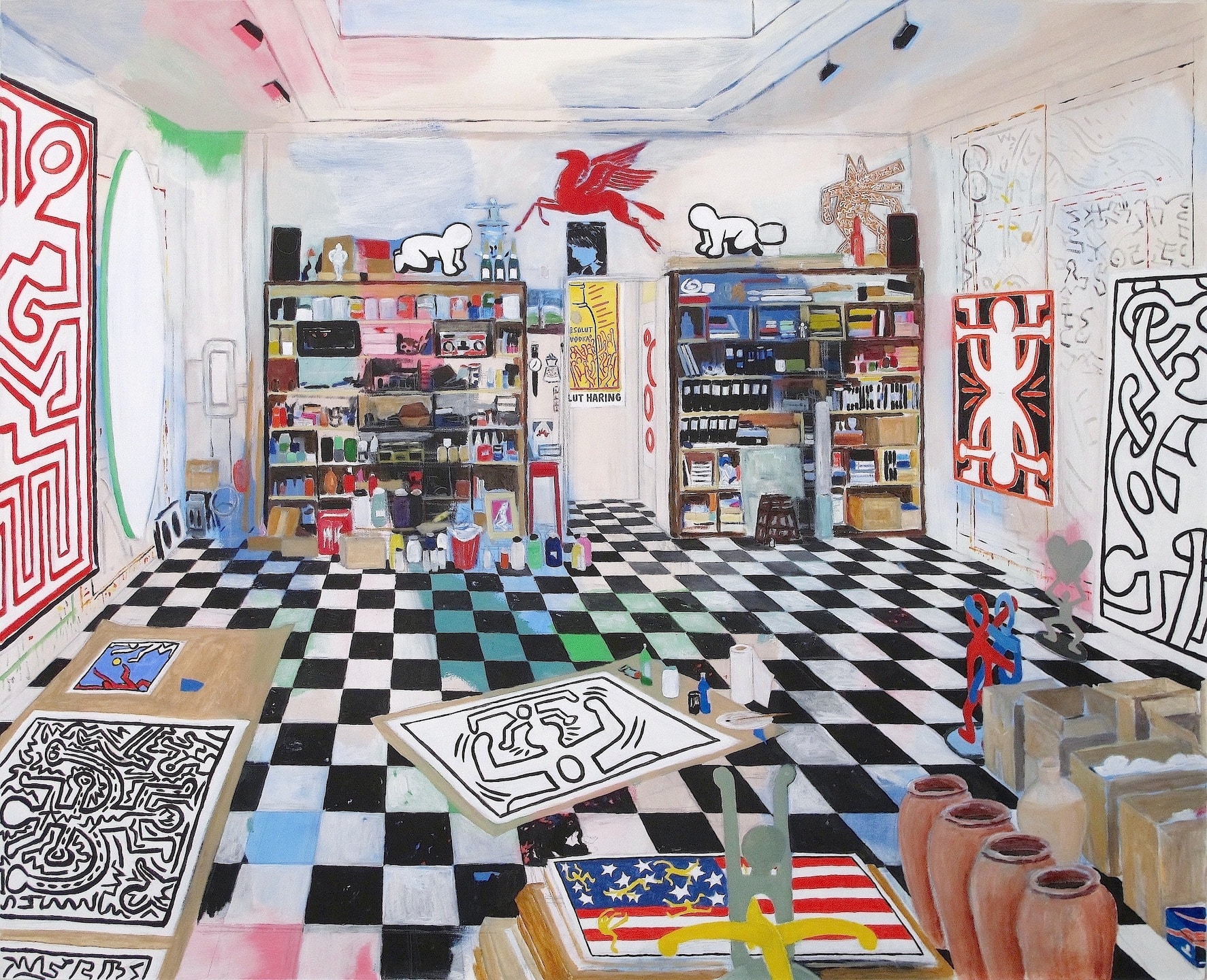
In the early 1980s, Elwes lived in New York, where he was an early exponent of graffiti. A chance encounter with Keith Haring in a New York subway led to the start of his career as an artist. He and Haring talked graffiti and Haring encouraged Elwes to start painting. “He was very approachable and magnanimous,” Elwes says. Haring insisted that Elwes make a painting before they spoke again.
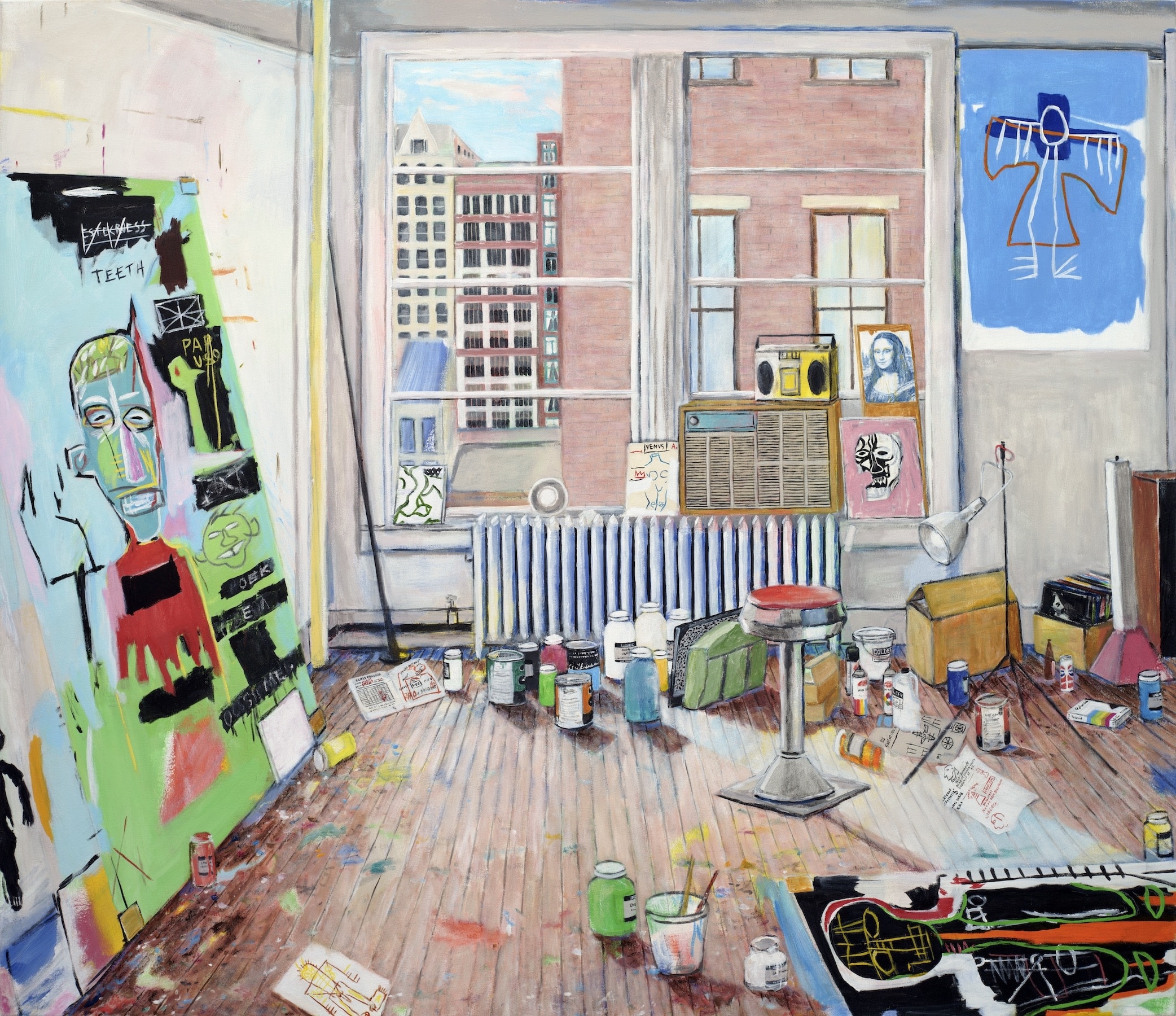
Some of his first paintings were chosen by the eminent London art dealer, Robert Fraser, to be included in a graffiti exhibition with Jean-Michel Basquiat at the Fruitmarket Gallery in Edinburgh in 1984. Following the exhibition Elwes went to Paris where, for two years, he made paintings of the studios of contemporary artists as a way to learn from them.
“Instead of going to art school, I went to Paris to learn to paint. I didn’t know anyone and had no studio there, but I had read Matisse’s advice to young artists, that they go to museums and copy favourite artworks.” Damian Elwes.
With a limited knowledge of French, Elwes sought out artists studios across the city and persuaded them to allow him to sit in the corner and paint their studios. Although he didn’t realise it at the time, Elwes had embarked on a project that was later to lead to some of his most memorable and spectacular paintings.
COLUMBIA AND LA
Following his time in Paris, Elwes moved to Los Angeles, set up a studio, married, and embarked on a different path. For seven years, he and his wife, Lewanne, lived in Colombia making vast paintings of the threatened rainforest. The paintings explored themes such as the cycle of life and creativity, sometimes on a monumental scale.
They returned to LA in 2000 when Colombia became too dangerous. Back in LA, his early obsession resurfaced, and he started researching artists’ studios, beginning with Picasso. That was how it all began.
THE STUDIO PAINTINGS
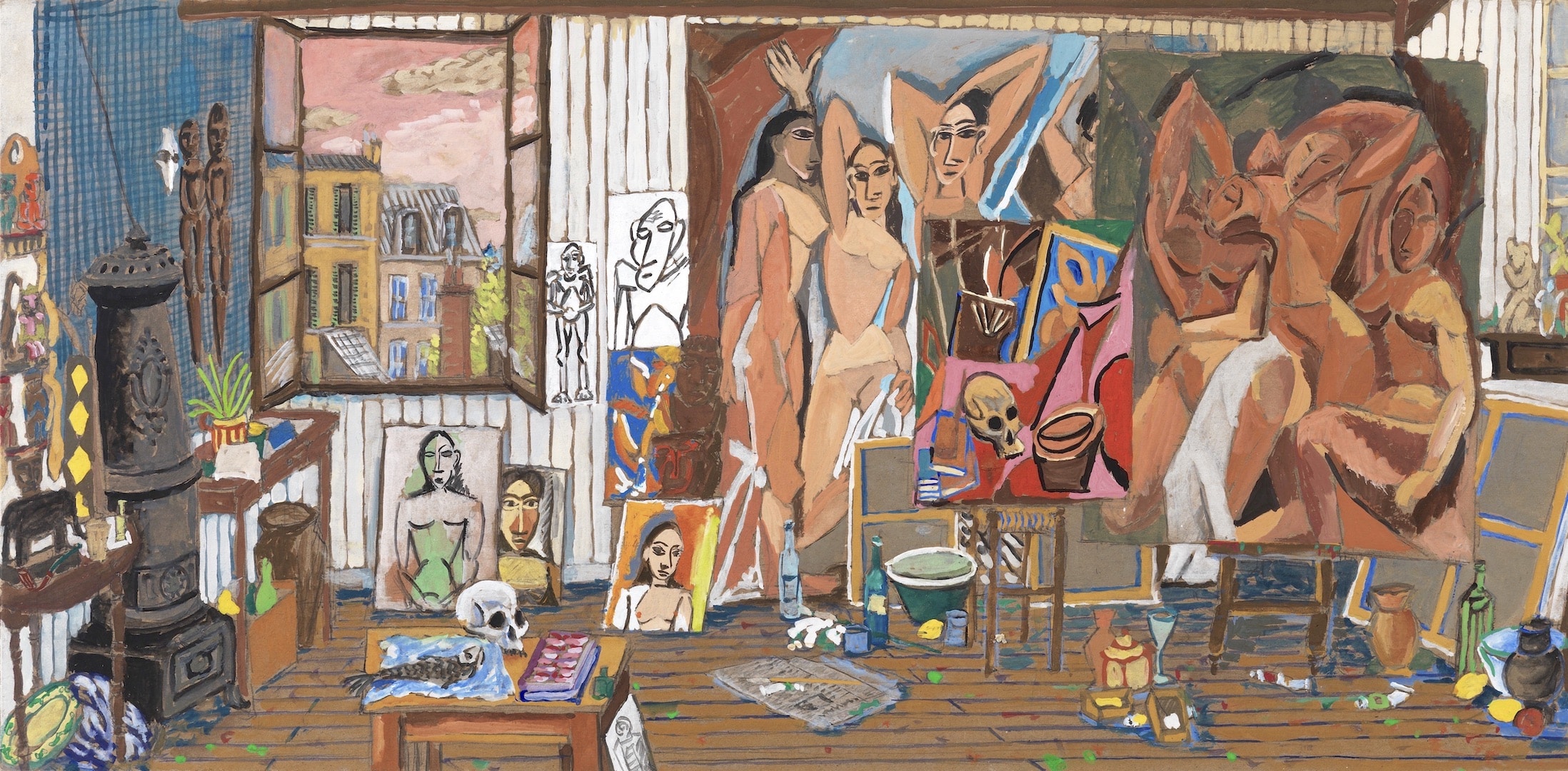
Back in LA, Elwes invested in a computer and the first thing he googled was Picasso’s ‘Bateau Lavoir studio.’ Nine small photographs appeared on the screen and Elwes began to draw from them, trying to reconstruct a studio long since destroyed.
“I couldn’t make sense of what the studio looked like. Then I saw the hand of one of the Demoiselles d’Avignon in one of the photographs. I looked at the others, and there was the arm of the opposite demoiselle in another photo. I printed up ‘Les Demoiselles d’Avignon’ and suddenly I could attach all the photographs together like a jigsaw puzzle and see what it looked like. That was the breakthrough painting. I wanted to be a fly on the wall and see what was going on in the studio of my heros.” Damian Elwes
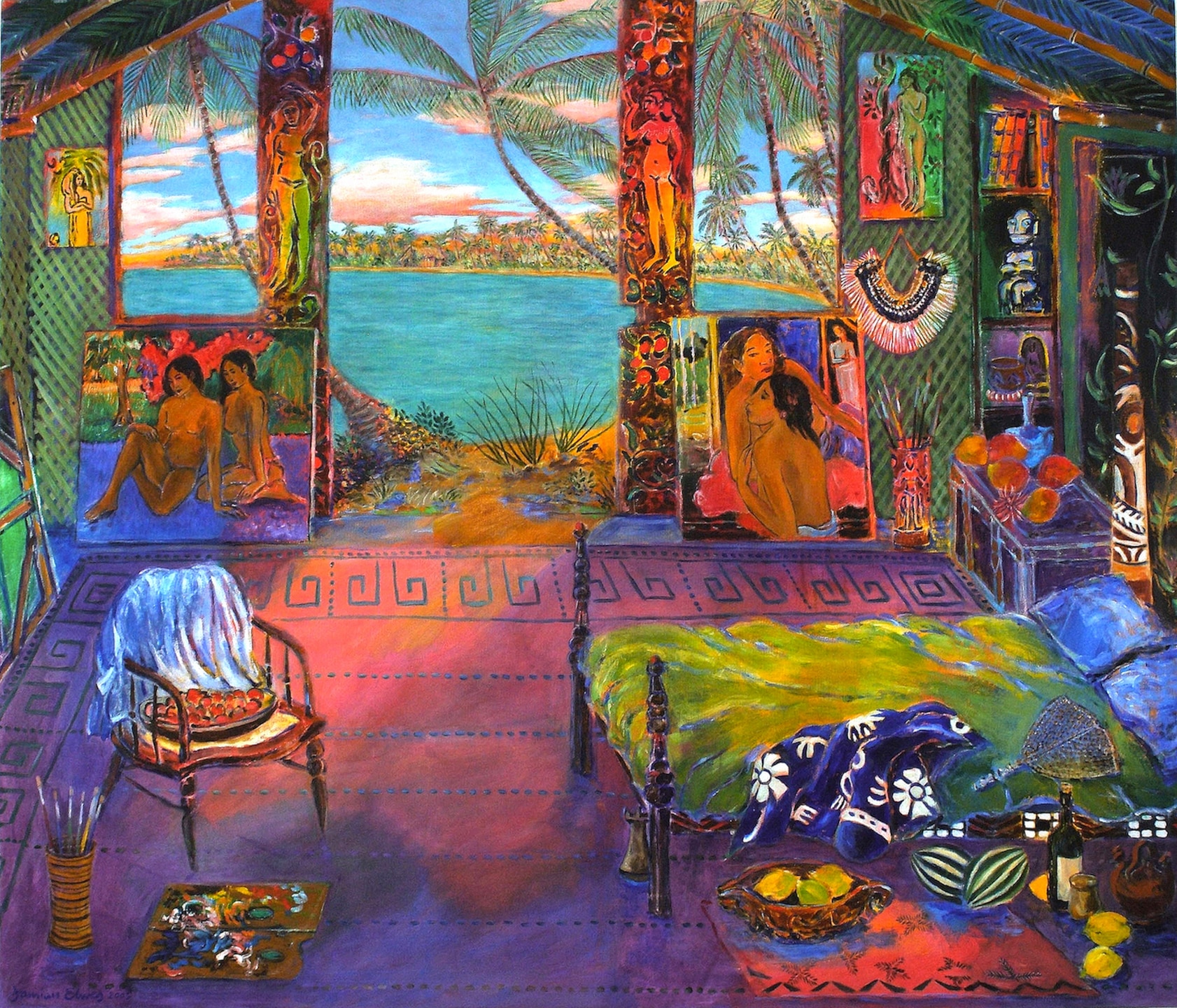
Elwes has painted over 200 artist studios, including those of Monet, Cezanne, Gauguin and Frida Kahlo, visiting the spaces and buildings where each artist worked. Using photographs to piece together the stories, combined with meticulous research, he has been able to recreate each studio as authentically as possible.
‘What actually sustains, even heightens our interest, is Damian Elwes’ ability to turn documentation and historical record into compelling pictorial visions requiring repeated viewing and constant deciphering. Elwes’ concern for historical accuracy, and his subsequent investigative process enable his fully realized paintings to have a freshness and immediacy which none of the source material contains nor conveys. It is not, therefore, the fact that he has painted Picasso’s studio that makes Elwes’ work of interest. Rather, it is his ability to use the historical source material about Picasso to achieve some immediacy for his own concerns as a painter. In the end, it is the expressive quality of these works that we feel drawn to.” Curator Fred Hoffman
In 2018, the Musée en Herbe in Paris hosted ‘Secrets of the Studio, from Claude Monet to Ai Weiwei’ a retrospective of Elwes’ Artist Studio paintings. More than one hundred thousand people attended his immersive and interactive exhibition. Visitors could walk through Picasso’s Villa in Cannes or roam around in a VR painting of Brancusi’s original Montparnasse workshop.
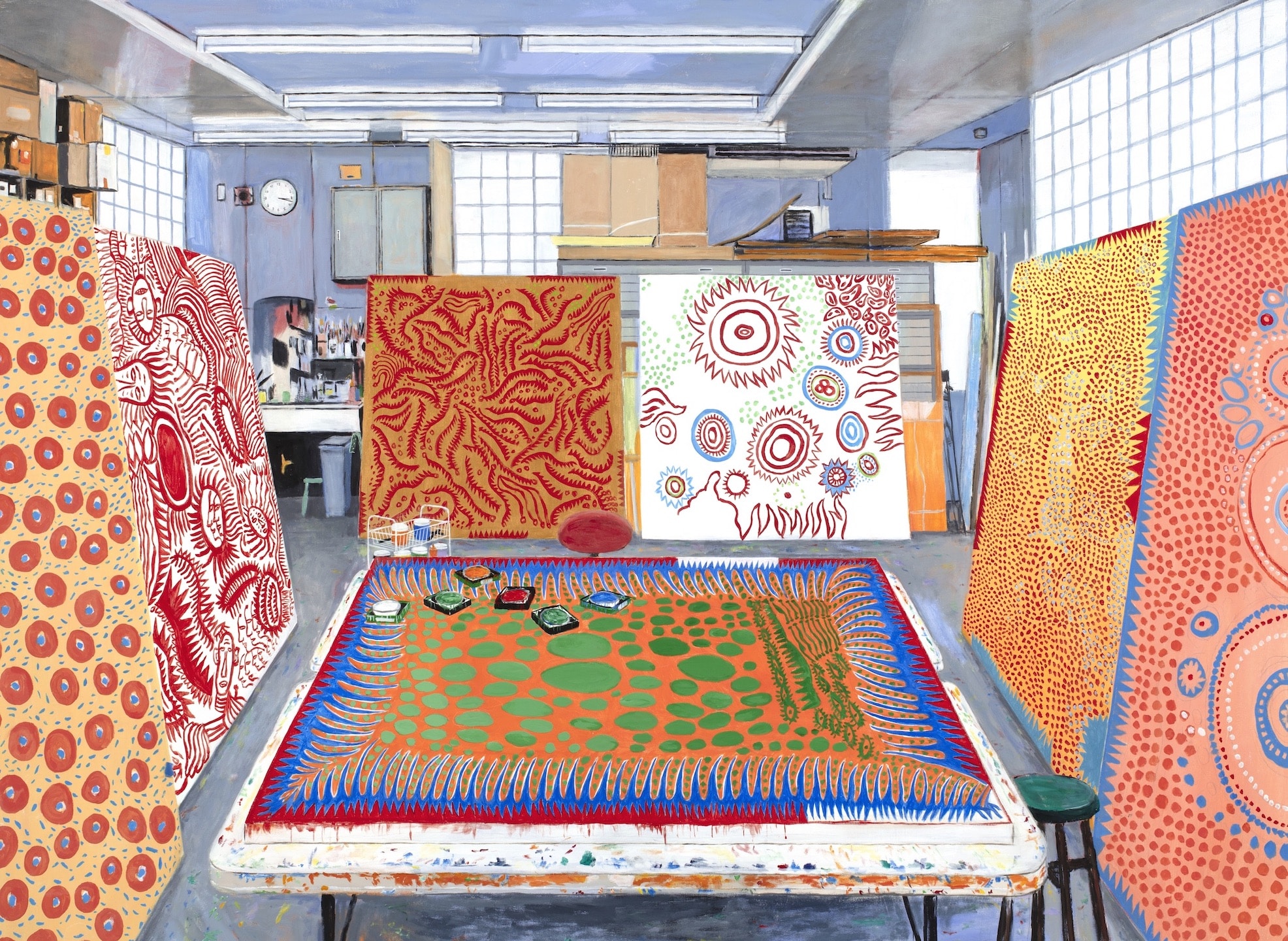
During the summer of 2019, Elwes visited the studios of Lichtenstein, Frankenthaler, Haring, Katz, Rothko, Hesse, Kusama, Basquiat and Kelly in New York City, Twombly’s studio in Gaeta, and the studios of Rose Wylie and Lucian Freud in London. Since then, he has been busy recreating their studios as paintings, trying to describe moments in time when those artists were at their most inventive. “I had to take on these particular artists because they loom so large in my head that they can be overwhelming.” Damian Elwes
“I love painting so much, because it’s in my blood. And because I’m a third-generation artist. Painting has been around since cave painting and it’s going to be around a long time from now.” Damian Elwes
If you have enjoyed this spotlight on Damian Elwes, watch the video where the artist talks about his studio paintings, on the link below.