
SANDRA BLOW (1925 – 2006)
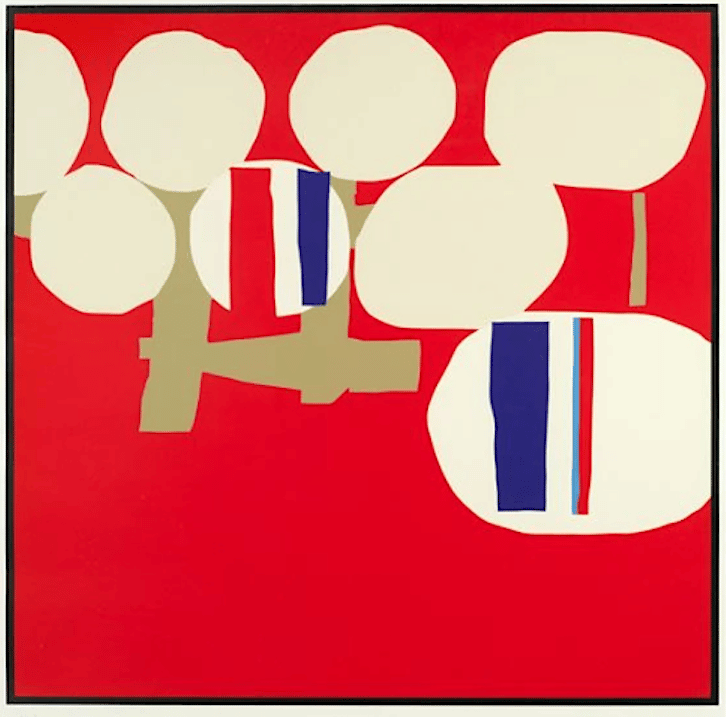
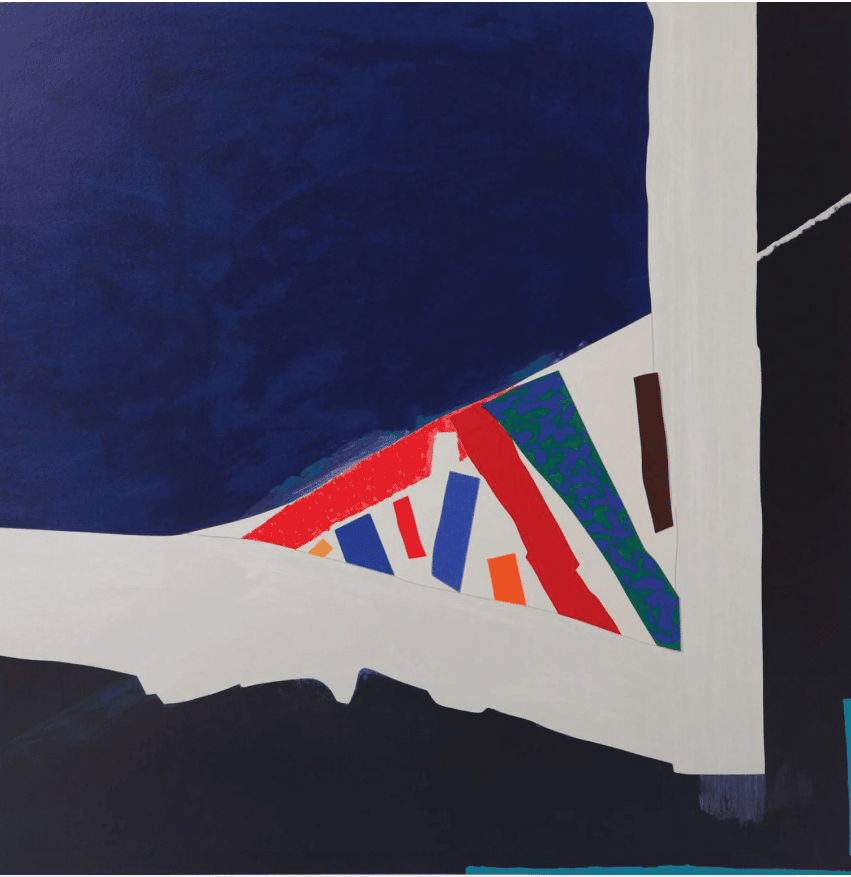
Born in London, Sandra Blow was an English abstract painter and one of the pioneers of the British abstract movement of the 1950s. She stands as one of the earliest and most original female abstract painters in Britain. Blow’s works are characteristically large scale, colourful abstract collages made from discarded materials.
View all Works


THE EARLY YEARS
After leaving school at 14, Blow enrolled at Saint Martin’s School of Art in 1941, where she studied until 1946 under teachers including Ruskin Spear. During this time she joined the artists’ social scene, meeting people such as Lucien Freud, John Minton and Francis Bacon. She spent a short period in 1947 at the Royal Academy Schools, but found the teaching dull, so instead travelled to Italy to study classic art. There she was inspired by Nicholas Carone to enrol at the Accademia di Belle Arti in Rome where she met Alberto Burri, an Italian artist and one of the most prominent abstract painters of the 20th Century. It was through him that she started to use ‘non-art’ materials, such as sacking, liquid cement, chaff and charcoal. She began a relationship with Burri that would influence her work for the rest of her life and the pair would create works in response to each other throughout the 1950s and 60s while Burri rose to international recognition.
Blow and Burri travelled together in Italy in 1948 and later in Spain and France in 1949 where they worked together in Paris. Blow eventually found Burri’s influence too overwhelming and returned to the UK in 1950 to pursue her work free of his influence. Blow now faced the challenge of not only establishing herself as a woman artist in the 1950s but also as an abstractionist.
THE WORK
Sandra Blow’s abstract paintings integrated diverse materials, such as sand, ash, plaster, wire and sacking. She combined collage with acrylic paint, introducing distinct patches of flat colour and well-defined forms which gave an added surface and depth to her compositions. Her uncompromising approach pushed printmaking techniques to new boundaries with the introduction of Hessian, film and cloth, creating prints that border on sculptural.
Unlike some of her American contemporaries, careful composition eliminates gestural expression and there is a delicate coherence in her treatment of pictorial space. Her work examines the interplay between the key principles of nature: space, colour and texture. Her approach has been linked to that of the Constructivists and with fellow St Ives painters Roger Hilton and Ben Nicholson. Blow’s later works demonstrate a greater use of colour and a painting collaboration with Eric Defty in the 1970s led to the introduction of simple, geometric forms alongside the organic, resulting in more architectural compositions.
CAREER
The first sale of any of her works was to Roland Penrose, a founder of the Institute of Contemporary Arts, which proved to be a pivotal moment in her career. Blow’s success continued when the leading London gallery, Gimpel Fils began representing her work from 1951. Under Gimpel Fils, Blow had regular exhibitions and secured her first solo show in New York. The gallery also represented St Ives artists, including Barbara Hepworth, Ben Nicholson, Peter Lanyon, Terry Frost and Wilhemina Barnes-Graham. The association with such artists anticipated her move to the Cornish coast for a year in 1957. Blow developed a life-long connection with St Ives and later made it her permanent home.
In 1957 Blow featured in the first John Moores biannual exhibition in Liverpool, and a year later was included in the Young Artists Section at the Venice Biennale. Around the same time, Blow’s work started to be exhibited abroad, including Italy, Holland, Germany, the United States and later Australasia. In 1960, she won the International Guggenheim Award and in 1961 gained second prize at the John Moores exhibition at the Walker Art Gallery. In the same year, the artist returned to London and became a tutor at the Royal College of Art painting school at a time when artists such as David Hockney, Patrick Caulfield and R.B Kitaj were among the students. Blow stayed at the Royal College of Art for fourteen years and was appointed an honorary fellow in 1973. She was elected to the Royal Academy in 1978.
Although Blow often exhibited locally around Cornwall she fulfilled her obligations as a Royal Academician and participated in every Summer Exhibition at Burlington House, where she also had a retrospective at the Sackler Gallery in 1994. Her work is featured in numerous collections, including Tate Britain (London), Victoria and Albert Museum (London), The British Council, The Contemporary Arts Society (London), Fitzwilliam Museum (Cambridge), Museum of Modern Art (New York), and National Gallery of Victoria (Melbourne, Australia). To celebrate her 80th birthday, a celebratory exhibition was held at Tate St. Ives with a publication on her work by Michael Bird in 2002. Sandra Blow died in 2006.
View all Works