
DAVID SPILLER (1942 – 2018)
“I really want to make paintings that put some magic on the wall. Some of them are straightforward things. Some are wild things. But underneath, it says ‘I love you.’” David Spiller
View all Works


THE EARLY YEARS
David Spiller was born in 1942 in Dartford and grew up in the small town of Swanley in Kent. At the age of 15 he started a graphic design course at Sidcup Art School followed by a fine art painting course at Beckenham School of Art where he was classically trained in painting and drawing. This is where he also started to develop a lifelong passion for music of all kinds: rock‘n’roll, rock, the blues and music from the movies. In 1962 he gained a place to study at the Slade School of Art, where he was taught Frank Auerbach and William Coldstream and where he won the Henry Tonks Prize for Drawing.
BACKGROUND AND INSPIRATION
David Spiller belongs to the Pop tradition, but he is in no sense an orthodox Pop artist. He is a graffitist, but manipulates scribbled inscriptions and images very much to suit himself.1 Being younger than the Pop artists, Spiller developed a different approach and offered another comment on the new mass-market urban culture. While Pop Art was interested in finding striking images and presenting them boldly, Spiller’s focus became urban graffiti, in an approach much closer to Dubuffet or Cy Twombly.2
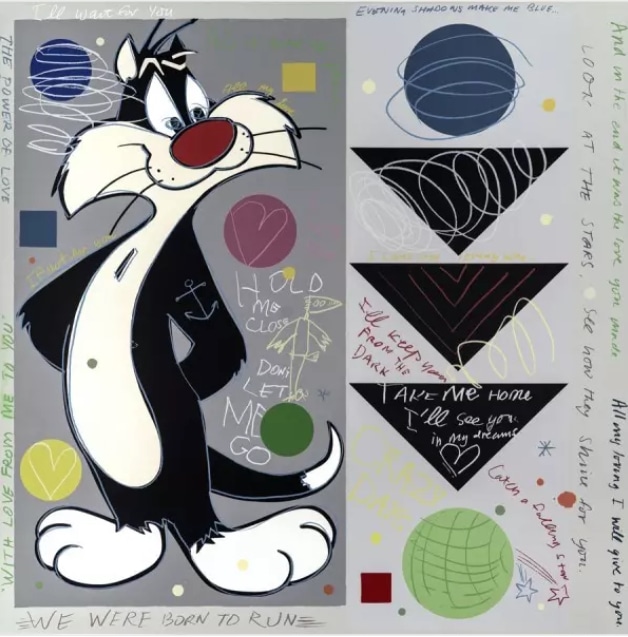
Spiller’s art is filled with enthusiasm and energy. Recycling concepts from popular culture and childhood memories, his iconic images have an immediate and infectious appeal. A spirit of collaboration is central to Spiller’s work, most obviously in his use of found images from comic strips and in his appropriation of lyrics from popular songs.3
Spiller says these songs are the soundtrack to his life. They continually run through his head, whether he wants them there or not…. Popular music of this kind now represents the continuity of Western culture – something in which most of us share and which creates a common bond…… What matters to David Spiller is the idea of continuity – ordinary life, lived as most people live it, is for him an inseparable part of the process of making art. The songs ripple through his day as he works to solve the many visual problems he has set himself. They are part of what makes the work seem ‘real’ – an element that binds him to the society in which he lives.4
THE WORK
By using different painterly techniques he creates rich and complex surfaces, blending bold Pop Art colours with expressionistic painting and hard-edged abstraction. To these striking images he adds another layer of informal freehand texts and drawings, including characters and motifs that echo in his mind, combined with evocative lines from his favourite songs. He compares his paintings to architect-designed buildings onto whose walls people have written graffiti.5
THE PRINTS
The uplifting and universal appeal of David Spiller’s work resulted in a strong demand for his paintings, firstly in Belgium and mainland Europe and later in the UK. Spiller started publishing his paintings in response to this demand, enabling a wider audience to enjoy his iconic images.
Working in close collaboration with his publisher Harwood King, the prints were made by hand and published in limited editions, signed and numbered by the artist during his lifetime. Following his passing, and as the market for his work remained strong, his family decided to publish new editions posthumously. These new editions are now signed by his partner Moira and son Xavier and each print comes with a full certificate of authenticity.
If you have enjoyed this spotlight on David Spiller, watch the print production process here.
“Love is all there is, it makes the world go ’round, Love and only love, it can’t be denied. No matter what you think about it, You just won’t be able to do without it. Take a tip from one who’s tried.” Bob Dylan ‘I threw it all away’
1Edward Lucie-Smith 2007, 2Tom Hewlett 2016, 3Marco Livingstone 2001, 4Edward Lucie-Smith 2010, 5Marco Livingstone 2001, 6Marco Livingstone 2001
View all Works